

How Did The Speaker Register In Terms Of Credibility ?
Read Feedback Cues
Feedback is the verbal and non-verbal responses from an audience which help the speaker modify and regulate what s/he is saying.
Learning Objectives
Apply your observations of feedback from your audience to modify your speech
Key Takeaways
Key Points
- Verbal feedback –during the voice communication you may solicit feedback from the audience by asking a uncomplicated question to become feedback from the audition.
- Non-exact feedback–When you are in front end of the audience, non-exact behavior can be an important cue to what the audience understands, the level of attentiveness, excitement or agreement, or confusion or disagreement.
- Audience Response Organisation– capture feedback from a big or remote audience by using an audience response system to ask questions and and so display the answers. Audience members can answer using a wireless keypad such as a clicker, SMS, or text using a smartphone.
- You lot can utilise the responses every bit personal feedback to change your bulletin or you can share them with the audition by displaying the tabulated responses on a spider web page or projected every bit part of a PowerPoint presentation.
Central Terms
- feedback: The receivers' verbal and nonverbal responses to a message, such as a nod for understanding (nonverbal), a raised eyebrow for being confused (nonverbal), or asking a question to clarify the bulletin (verbal).
Read Feedback Cues
Feedback is the response from the listeners
Feedback is the response that listeners provide to the sender of the message. Feedback is a cue to the speaker to modify or regulate what is being said. Feedback can take the form of verbal or non-exact responses to an in-person speech, or verbal responses which are electronically captured for large or remote audiences.

Receiving Feedback: Information technology is important for the speaker to receive feedback from the audience.
In-Person Verbal and Non-Verbal Feedback
Verbal Feedback
During the speech yous may solicit feedback from the audience by request a simple question. Audience members may answer verbally or they may nod or raise their hands. Additionally, audience members may ask a question or let you lot know if they do not understand. Yous may besides receive straight positive or negative feedback from members of the audience who concur or disagree with what you are proverb. Listen for the verbal feedback and acknowledge it.
Non-Verbal Feedback
When you are in forepart of the audience, non-exact behavior can be an of import cue to what the audience understands, the level of attentiveness, excitement or understanding, or confusion or disagreement. The non-verbal feedback may be intentional vocalizations, such every bit groans or encouragement (such as clapping). Nevertheless, much of the non-exact feedback may exist unconscious concrete body language, which can provide feedback for you. Here are some examples of trunk language that you lot may observe displayed consciously or subconsciously by members of the audience:
- Colorlessness: colorlessness is indicated by the head tilting to ane side, or by the eyes looking straight at the speaker only condign slightly unfocused.
- Disbelief: this is ofttimes indicated by averted gaze or by touching the ear or scratching the chin. When a person is not being convinced by what someone is maxim, the attention invariably wanders and the eyes will stare away for an extended period.
- Attentive eye contact: Are audience members looking directly at you intently or are they looking around? Consequent eye contact tin can betoken that a person is interested and thinking positively about the speaker's subject. Nevertheless, if a person is lilliputian with something, even while directly looking at you, it could indicate that the attention is elsewhere.
- Body position and posture: Audience members will generally confront the speaker while listening intently; if the audition members are non interested they may shift the torso position to the side rather than toward the speaker.
If you maintain eye contact with your audience while speaking, yous tin can discover the cues and suit your message. What is your audience telling y'all? All the non-verbal feedback needs to exist processed with knowledge of the cultural context of the speaker and the audition. Recall that people from different cultures do translate body language in dissimilar ways. For example, eye contact can be misleading because cultural norms virtually it vary widely. Direct heart contact may show attentiveness to the North American speaker but be considered a confrontation in another civilization. And, sure paw gestures that are perfectly acceptable to one group may be disrespectful to another audition.
Feedback Electronically Captured from Large or Remote Audiences
You can also capture the responses from the audition by using an audience response organization that you tin can view privately as y'all speak or display to the audience. You can solicit feedback directly by asking multiple choice, true-false, or numerical questions from audience members who respond using a wireless keypad such equally a clicker, SMS, or text using a smartphone. The feedback from the audience is so sent back to your computer and processed by the audition response software. For a large or remote audience, y'all can plan to include different questions or polls to capture feedback from your audience and adjust your message accordingly. Information technology is necessary to structure the questions to go the feedback you want. For example, if a large per centum of your audition answers a question with a certain incorrect answer, you will know that y'all need to explicate that concept differently. Conversely, if a large pct of the audience agrees with an opinion, you tin use that feedback to adapt your bulletin.
Timing of Feedback
Cess, or the tactics speakers and audience members use to facilitate learning, is often divided into initial, formative, and summative categories.
- Initial assessment, also referred to as pre-assessment or diagnostic assessment, is conducted prior to pedagogy or intervention to constitute a baseline from which an individual'south growth can be measured.
- Formative assessment is generally carried out throughout a course or project. Determinative assessment, besides referred to as "educative cess," is used to aid learning. For case, in an educational setting, formative assessment might be a teacher (or peer) or the learner, providing feedback on a student's work and would not necessarily be used for grading purposes. Formative assessments can take the course of diagnostic, standardized tests.
- Summative assessment is generally carried out at the end of a course, project or voice communication. In an educational setting, summative assessments are typically used to assign students a form grade. Whereas following a speech or presentation, summative assessment tin be provided in the form of positive feedback, applause or a standing ovation.
Concur the Audience'southward Attending
To hold the audience'due south attention, consider their readiness to perceive, the option of stimuli, and how to maintain electric current awareness.
Learning Objectives
Apply strategies for maintaining audience focus
Central Takeaways
Key Points
- If the speaker can establish readiness past getting the audience 'southward attending during the first 25-30 seconds of the voice communication, he or she can then direct and focus that attention to the important parts of the message.
- The speaker tin can direct the attention of the audience to what is important by using changes in rate and volume, torso motility, and gesture to emphasize what is important.
- It is important to read the non-verbal clues of the audience to sympathise if they take shifted their attention somewhere else.
- If the audience's attention is shifting from the speech, claiming the audience with an enquiry to stimulating thinking.
- In that location are many strategies to apply to concur the attending of the audience, but the nigh of import is the ability to plant and maintain a genuine connection with the people in the audience.
Key Terms
- Perception: Conscious agreement of something; acuity.
- awareness: The state or ability to perceive, to experience, or to be conscious of events, objects, or sensory patterns. In this level of consciousness, sense information tin can exist confirmed past an observer without necessarily implying understanding.
To hold the attention of the audience, a public speaker should consider three important aspects of the process of perception: readiness to perceive, choice of certain stimuli for focus of attending, and country of current sensation.
Readiness to Perceive
The speaker is responsible for setting the stage. The speaker does this with the opening introduction in the the first 25 to 30 sections. If the speaker can secure the attention of the audition at the very beginning of the oral communication, he or she can then directly and focus that attending to the important parts of the message, as follows:
- Make certain that the room is gratuitous of noise and other distractions, to ensure that the audition is focused on the speech, rather than what is happening in the room.
- Speakers are often introduced by a host. This brief introduction is important considering it helps to constitute the speaker's credentials and prepares the audience members so their attention is properly directed.
- Remember that the first of import function of the introduction is to "capture the attention of the audience" and them immediately direct attention to the spoken language'southward main message.
Selection of Certain Stimuli for Focus
While delivering the speech, the speaker wants the audition to concentrate on his or her bulletin, and directs their attention to what is important through the employ of voice, body, and gesture. This is washed by emphasizing the important points by changing the charge per unit, volume, or pitch of the vocalisation. Using vocal variety purposely helps the audience know what is important and directs their attention to those elements. In addition, the speaker's body and gestures tin direct attention to of import aspects of the message (for case, past pointing to, walking to, or touching a visual help or diagram). Additional examples include the following:
- To understand where he or she wants the audience to direct their attention, the speaker can consider a quick internal summary of an idea.
- Employ signposts, such every bit "Now get this…" or "Here is the important betoken, which I want you to call back. "
- When using a visual aid, use additional audio cues or color changes to highlight specific areas.
State of Current Awareness
Speakers must read the non-verbal clues of the audience to understand if they have shifted their focus somewhere else. If the audition members are glancing at their watches, texting, or glancing at other people in the audience, the speaker should recognize the current state and redirect the attention dorsum to the speech communication'south message. To change the current state of the audition's awareness and re-gain their attending, endeavour the post-obit:
- Challenge the audience with an inquiry to stimulating thinking. Ask for a show of hands to vote or to requite answers, utilize clickers or an audition response system to get a response and and then share the result, or enquire a relevant question to stimulate idea.
- Engage in narrative as a modify of pace from message delivery. Create a narrative that is relevant to the topic and is dramatic for the audience, and utilize a surprise catastrophe to straight the audience attending to the message.
- Provide physical examples of a concept or main point that is directly relevant and engaging for the audition. Brand a comparing to something that has recently happened in the community or nationally.
- Stimulate the audience's imagination or take them on a fantasy journey that stimulates the different senses. The more the senses are stimulated, the more the current focus is on the speech's message.
At that place are many strategies that the speaker can employee to hold the attention of the audience, but the most important is the ability to institute and maintain a genuine connection with the people in your audience. Speakers don't need to use a choke-hold to keep the audience's attention.

Asphyxiate-concur: Speakers don't need to use a choke -hold to proceed the audience's attention.
Maximize Understanding
To maximize understanding, use full general rhetorical strategies and other approaches that build upon the audition's prior experiences.
Learning Objectives
Give examples of means to help your audience understand your ideas
Key Takeaways
Key Points
- We depend on the employ of words applied in various rhetorical strategies to commutation understandings.
- Y'all can apply prior knowledge of the audience to cull the right vocabulary, to make comparisons with things familiar to them, to bear witness the origin of things, to grouping things into categories meaningful to them, and to number the steps or events in the order that they occur.
- To increment understanding during a speech, you tin take the perspective of the audience to restate ideas, to ask the audition questions, and to paraphrase what yous have only said using different examples and choice of words.
Key Terms
- comparing: An evaluation of the similarities and differences of i or more than things relative to each other.
- understanding: The mental (sometimes emotional) process of comprehension, or the absorption of knowledge, which is subjective by its nature.
- classification: The act of forming into a course or classes; a distribution into groups, as classes, orders, families, etc., co-ordinate to some common relations or attributes.
The Elements of Understanding
Understanding involves comprehending or knowing near an object, idea, concept, or process. In essence, yous want the audience to comprehend and share the same understanding. Information technology would exist a very simple procedure if yous could just substitution memory modules for your audience to upload, simply nosotros are not there nevertheless. Today, you will employ words to explain your thoughts. Here we are concerned with how you might use unlike rhetorical strategies to maximize what the audition understands.
Applying Prior Knowledge about the Audience
Apply what y'all already know about the demographics, background, and life experiences of the audience. Ask yourself, "What does my audience already empathise or know? " You can apply the knowledge to maximize understanding.
- Linguistic communication selection and vocabulary: You'll want to begin your caption at the right level; ask yourself, "What vocabulary volition my audition understand and what do I need to explain before I tin can explain other concepts? "
- Compare and contrast based upon shared noesis: When you are showing how two things are alike, create connections with what the audience already knows. In order to maximize understanding, you'll want to compare those things that are already familiar against the new and unfamiliar things. Then, you lot can demonstrate how they are the same or different.
- Visualize transformation by crusade and origin: Where did something come from and how did it become to its present state or status? Help the audience picture show the change from ane state or status to some other.
- Classification and grouping alike things to course a concept: First, you'll desire to cite examples that are familiar to the audition and put them into the aforementioned classification. And then you can put other less familiar objects or ideas into the same class or group while using the same characterization. You tin can fifty-fifty assistance the audience generalize to create a classification. For example, permit's say you see a fir, a willow, and a linden. By comparing these objects, you observe that they are different from one another in respect to the trunk, branches, leaves, and the similar; a farther comparison, still, reveals what they take in mutual: the body, branches, and leaves themselves, which form the abstraction from their size, shape, and so forth. Thus, you proceeds a concept of a tree.
- Sequence and origin: Here you help the audition empathize the process or sequence of events in time. You tin clearly listing and number the steps or events in the club in which they occur. In addition to using sequencing words, you tin also utilise simple mnemonics, like the knuckle mnemonic, which helps the listeners sequence things such as how many days are in each month.
Applying General Strategies
- Perspective-taking: Practice perspective-taking and then you tin frame and reframe your examples in a manner that the audition members will understand. You lot'll want to encounter how the members of the audience organize the world cognitively in guild to reframe your concepts then that the audience understands them. If your initial explanation is not effective with a particular audition, you may reframe and refocus on different aspects of what yous are explaining.
- Repetition: Build upon prior agreement of concepts past repeating and using internal summaries. This ensures the audience does not miss an important thought that is critical to agreement the whole message.
- Questioning: Question your audience to encounter if they sympathise what y'all are maxim, and conform your caption in order to clarify misunderstandings.
- Paraphrase: Paraphrase what y'all said for the audience and recapitulate the ideas using different examples. Different audience members may not understand ane idea but may sympathise some other that relates more than straight to their prior cognition.
Just put, you'll want to acquire how the audition conceptualizes the world and so employ that knowledge to maximize understanding. Use your skills of restating, questioning, perspective-taking, and paraphrasing to assistance clarify and reinforce understanding as you speak.
Build Brownie
Aristotle established iii methods of proof to build brownie: initial, derived, and terminal.
Learning Objectives
Give examples of means to build credibility before, during, and after your voice communication
Cardinal Takeaways
Central Points
- Credibility is not a characteristic of the source or speaker just an attitude in the mind of the listener(s). You may have high credibility with one group of listeners and low credibility with another.
- Building initial brownie—your initial credibility is your personal brand. The audition may know you prior to the spoken language. If non, have someone introduce you or provide relevant background every bit a self- introduction.
- Edifice derived credibility—When you speak confidently and assertively you inspire others with your energy and words. To build brownie you want to look at everything you do in the speech such every bit appearance, delivery, word pick, and in full general how you handle yourself.
- Building derived brownie—You found common ground with the audition past sharing aspects of your background that are similar to the audition, past using supporting examples or experiences that you and the audience have in common, and past creating a bond with the audience.
- Concluding credibility—You can build credibility for your adjacent speech by establishing a rapport with the audition so they walk away with a more positive view of y'all than when you started.
Cardinal Terms
- credibility: The objective and subjective components of the believability of a source or bulletin.
- Aristotle: An ancient Greek philosopher (382–322 BC), pupil of Plato, and teacher of Alexander the Great.
- ethos: A rhetorical appeal to an audience based on the speaker/writer's credibility.
Build Credibility
Edifice Credibility through Character and Competence
Aristotle, the classical Greek philosopher and rhetorician, established 3 methods of proof— logos, ethos, and pathos.
Logos is the logical development of the message, desolation is the emotional appeals employed by the speaker, and ethos is the moral character of the speaker as perceived by the audition. Our focus on credibility relates to ethos, the ethical grapheme and competence of the speaker. To build credibility you desire to focus on three stages: (1) Initial brownie is what the audience knows and their opinion prior to the speech communication, (two) Derived (during) credibility is how the audience perceives you while delivering the spoken communication, and (3) Terminal is the lasting impression that the audition has of you as they leave the voice communication.
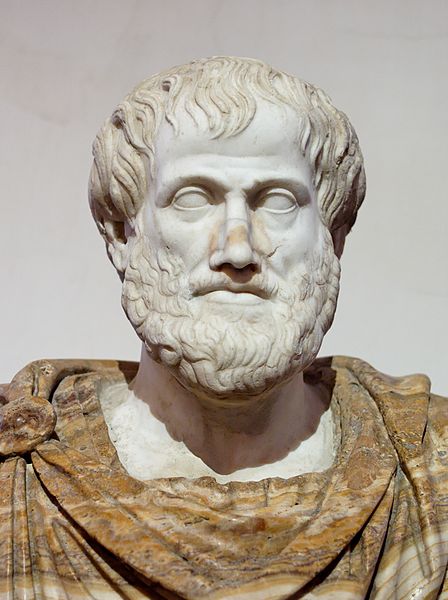
Bust of Aristotle: Marble, Roman copy after a Greek bronze original by Lysippos from 330 BC; the alabaster mantle is a modern add-on.
Edifice Initial Credibility
Here nosotros look at who you are every bit a person; what the audition knows most your expertise and whether the audience thinks yous are trustworthy. Yous may think about initial credibility as your personal branding: who you lot are and what y'all audition knows near you. Your reputation may precede you but if it does non, you may rely on an introduction prior to the speech. Oftentimes a host or moderator will introduce you and provide relevant information about your background. If there is no moderator to provide an introduction, yous may include a brief self-introduction about yourself as it relates to the topic and your motivation for speaking. Building initial brownie helps prepare the audience for what is to come during the speech.
Building Derived Brownie
This is where you want to look at how the audition perceives you during the speech communication. Yous derive brownie during the speech by what you do. Your credibility with the audition derives from how the audience responds to what you wear, the words you utilise, your delivery, and in general the fashion you handle yourself during the speech. If you utilize strong supporting evidence and explain it to the audience, you lot volition enhance your perceived competence. If you communicate sincerely and honestly with the audience, you will enhance the perception of your graphic symbol. If you lot speak confidently and assertively, while demonstrating a genuine concern for the audition, y'all volition increase your brownie with the audience.
Another of import attribute of brownie during the speech is your ability to establish common ground with the audition. Y'all tin establish common basis by sharing aspects of your background that are similar to the audience. Yous may likewise establish mutual footing through the selection of examples that you lot and the audience share in experience.
Plant common ground by creating a bond with the audience that will assistance the audience identify with you. For example, "I am like you, I share your concerns. " The audience is more likely to trust a speaker that they feel they know and who knows them.
Terminal Credibility
Equally a speaker, you want to build a rapport with the audition so they leave with as good or a better impression of you than when you lot began your spoken communication. Rapport occurs when two or more people feel that they are in sync or on the aforementioned wavelength considering they feel similarly or relate well to each other. In a sense, what y'all send out—the audience sends back. For example, they may realize they share similar values, beliefs, noesis, or behaviors around sports or politics as you deliver your speech and regard y'all more favorably than before you lot started your oral communication. You can build credibility for your next spoken language by establishing rapport with the audience. If you lot are honest and ethical with your audience and share your values and beliefs, you establish a rapport that will carry over beyond the speech.
Inquire yourself, "Will my audition trust me ?" We are non really talking about a feature of the source or speaker, but an attitude in the mind of the listeners. You may have loftier credibility with one listener or group of listeners and low credibility with some other.
Make Messages Easy to Retrieve
Encoding (or registration), storage, and recollection contain the 3 main stages in the germination and retrieval of retentivity.
Learning Objectives
Demonstrate methods for helping your audience remember your message
Central Takeaways
Cardinal Points
- Creating mental images of objects, people, and things is one of the oldest memory tools presented in classic rhetoric.
- Creating an organizational scheme and positioning ideas, objects, or processes into a specific gild makes it easier for audiences to recall and reinforce through the scheme.
- Breaking upward long lists or series into smaller and manageable groupings of four to five items helps audiences recall the items.
- Associating your new idea with ideas that are similar and/or familiar to the audience ensures that the associations are meaningful and memorable.
- Repeating important ideas helps the audience remember and include internal summaries.
- Creating a brusque poem, special give-and-take, or link arrangement such as a story helps audiences visualize a connection between previously unconnected objects, ideas, or events.
Central Terms
- mnemonic: Anything (peculiarly something in verbal grade) used to help remember something.
- memory: The ability of an organism to tape information about things or events with the facility of recalling them later on at will.
- singularity: A proposed bespeak in the technological future at which artificial intelligences become capable of augmenting and improving themselves, leading to an explosive growth in intelligence.
Make Messages Easy to Retrieve
Memory refers to the process by which information is encoded, stored, and retrieved. From an information processing perspective, there are three chief stages in the germination and retrieval of memory:
- Encoding or registration: allows data that is from the outside earth to reach our senses in the class of chemic or physical stimuli
- Storage: creates a permanent record of the encoded information
- Retrieval, retrieve or recollection: calls back the stored information in response to some cue for use in a process or activity
If you could simply transfer your memory modules to the brains of your audience, speaking would exist obsolete. Cyborg retentivity transfer is not feasible notwithstanding, and we have not reached singularity with the audience, but we can develop our ideas and evangelize them in such a way equally to facilitate the transfer of information.

Remembering Data: Similar electronic memory cards, humans employ storage methods to permanently record thoughts and memories.
Principles for supporting retentivity
- Visual and Spatial orientation (Method of Loci) – This is i of the oldest memory aids presented in classical rhetoric. It allows items to be remembered through the mnemonic system, which includes mentally associat ing them with specific physical locations. For instance, you can create a mental prototype of a building or a city for your audience and so acquaintance unlike ideas or themes with each spatial area. Yous tin can then walk the audience through the area as you discuss each theme in the associated location.
- Ordering – You lot can create an organizational scheme or pattern, then position ideas, objects, or processes using the scheme for the listeners. If y'all consistently follow the scheme or pattern throughout the voice communication, it is easier to call up and reinforces the ordering, whether it is a natural order or one which you created for the speech. For instance, think well-nigh money. You lot have a scheme of value for 1 cent up to one dollar. You can put all the pennies, nickles, dimes, and quarters into their corresponding place in the club. It then becomes easier to count and remember how many of each y'all have.
- Limiting sets – You tin break up long serial into manageable smaller sets. When chunking, y'all want to group similar items together. Since the newest research suggests that short-term retentiveness capacity is iv-5 items, you lot want to break up long lists into meaningful and smaller groupings.
- Clan- Y'all make associations betwixt new ideas, concepts, or like ideas. You want to brand sure the association you create is actually meaningful to the members of the audition and will fit into their mental framework. For example, it is easier for an English language speaker to call back names in English or other European languages, where names are associated with everyday meanings (east.g. "Chocolate-brown") and with numerous known people who have that proper name, than it is for them to remember names in Chinese, where no such associations are known. The same concept applies in reverse for a Chinese speaker. Similarly, it is much easier to remember places, objects, or rooms in a building by proper noun than by number, considering names accept higher clan value than numbers.
- Affect – You tin likewise create a strong emotional connectedness for the audience by mentally 'painting' a vivid film for the audience. Y'all might describe an image of something that is extremely beautiful or ugly in the minds of your audition. The concept that is salient, baroque, shocking, or just unusual volition be more hands remembered.
- Repetition – Yous may repeat important ideas to help the audience remember, and include internal summaries then that you echo again what yous want the audience to remember.
- Mnemonic – Mnemonics are oftentimes verbal, such equally very short poems or special words used to assist with memorization (e.g., lists). For instance, if you desire the audience to call back the list (dog, envelope, 13, yarn, window), you could create a link system, such every bit a story almost a "dog stuck in an envelope, mailed to an unlucky blackness cat playing with yarn by the window. " Alternatively, yous could use visualization to imagine a dog inside a giant envelope, then visualize an unlucky blackness cat (or whatever reminds the user of 'thirteen') eating a huge envelope.
While nosotros expect for communication applied science and bogus intelligence to enable direct retention transfer, we tin can make practiced employ of these fourth dimension tested principles to make messages easier to remember.

How Did The Speaker Register In Terms Of Credibility ?,
Source: https://courses.lumenlearning.com/boundless-communications/chapter/helping-your-audience-listen-more/
Posted by: romeextrahmethe.blogspot.com
0 Response to "How Did The Speaker Register In Terms Of Credibility ?"
Post a Comment